


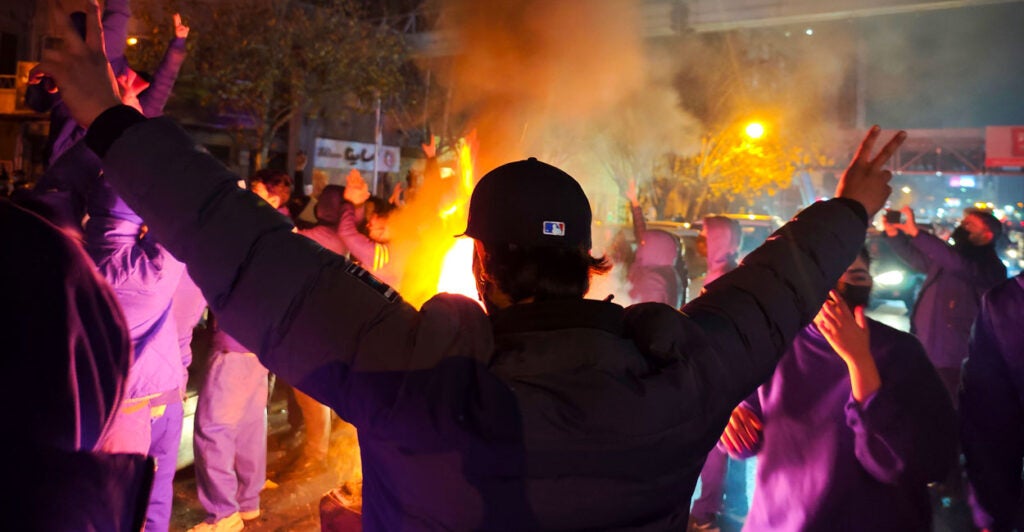
Iran stands at an inflection point. The Iranian people have risen up with extraordinary courage and on an unprecedented scale to demand a better future. The ayatollah regime has responded with lethal repression.
But the regime’s brutality cannot hide the fact that it has no answer to the forces driving the unrest: economic collapse, failure to provide basic services, and a society that increasingly rejects the regime’s ideology in favor of freedom, dignity, and human rights.
A new Iranian government that ends the export of terror, ceases its ambition for military nuclear power, and chooses constructive relations with the West rather than allying itself with America’s enemies would be one of the most consequential developments for Middle East and the global order in modern history.
President Donald Trump’s urging of Iranians to keep protesting, promising that “help is on its way,” while signaling that the United States is prepared to sustain and escalate pressure stands in stark contrast to the approach of recent administrations.
In 2009, Iranians filled the streets in the Green Movement with a simple question—“Where is my vote?”—and the regime answered with brutality.
Prioritizing a nuclear deal with the regime over the Iranian people’s democratic aspirations, the Obama administration all but ignored the protestors. In 2022, the “Woman, Life, Freedom” movement revealed once again the courage of Iran’s youth and women, but the regime survived through violence and fear, emboldened by Western inaction.
Today, however, Iran’s rulers face a new reality. Trump has restored American power and standing on the international stage. Internally, the country is gripped by skyrocketing inflation, deep corruption, and a catastrophic water crisis—problems driven by the regime’s mismanagement, its refusal to abandon its nuclear ambitions, and its determination to send billions of dollars to terror proxies abroad rather than invest in Iran’s own people.
Externally, the Islamic Republic’s moment of maximum regional power has passed. On Oct. 6, 2023, Tehran’s terror proxy network threatened Israel, destabilized Lebanon, endangered U.S. partners in the Gulf, and menaced global shipping lanes.
In the war that followed Hamas’ Oct. 7 massacre, Israel, with U.S. support, dealt devastating blows to Hamas and Hezbollah. American and Israeli strikes severely degraded the Houthis’ ability to threaten shipping and regional partners.
And the 12-day war, culminating in Operation Midnight Hammer, did not just destroy much of Iran’s nuclear infrastructure and ballistic missile arsenal, but dismantled key elements of Iran’s air defenses, leaving the regime in a state of heightened vulnerability.
In other words, the ayatollah emperor has been revealed to have no clothes. Yet even as the regime’s weakness is exposed and the people’s desire for change is unmistakable, the most important question remains unanswered: What comes next?
The best available data regarding the preferences of the Iranian people comes from the Group for Analyzing and Measuring Attitudes in Iran. Its June 2024 survey, based on anonymous responses from more than 77,000 respondents, found that 70% of Iranians explicitly oppose the Islamic Republic. An extraordinary 89% say they support a democratic system. Two-thirds reject governance based on religious law.
On the preferred alternative, Iranians are not unified around a single blueprint: about 26% favor a secular republic and around 21% support a constitutional monarchy. Reza Pahlavi, the son of the former shah, remains the most popular opposition figure listed, enjoying 31% support, but no figure is favored by a majority.
This mix of deep anti-theocratic sentiment, strong democratic aspirations, and fragmented opposition means both hope and risk. The hope is obvious. The risk is that a powerful force, such as the Islamic Revolutionary Guard Corps or elements of the military, could attempt to capture the state in the name of stability.
Still, if Iran’s future is a government that chooses normal relations with the world rather than theological extremism and revolutionary export, the strategic benefits for the United States could be historic.
First, such a shift could permanently extinguish Iran’s “ring of fire.” Tehran is the banker, trainer, and armorer of the region’s most destabilizing terror networks. A post–Islamic Republic Iran could reduce the threat to U.S. forces and allies, restore confidence in global shipping routes, and open the door to news regional integration architectures.
Second, it would strike a major blow to Russia. Today’s Iran is one of Moscow’s most important partners, supporting sanctions evasion and enabling Russia’s war machine. A new Iranian government seeking Western investment and sanctions relief would have strong incentives to sever that relationship.
Third, it would disrupt China’s strategic foothold in the region. Beijing has benefited from Iran’s isolation, importing discounted Iranian energy and using Tehran as an anti-American anchor in the Middle East. A normalized Iran, trading broadly and transparently, would reduce China’s leverage.
None of this will happen automatically. That is why America’s policy should be guided by a simple principle: support the Iranian people, deter mass repression, and prepare for multiple transition scenarios.
That means enabling communications and internet access during blackouts, documenting and sanctioning perpetrators of atrocities, and making clear that sanctions relief is available only in exchange for verifiable changes—ending terror exports, accepting robust nuclear and ballistic missile constraints, and respecting fundamental rights.
If the regime continues its brutal repression, a U.S.-led military response should follow.
The U.S. has the capabilities to deal a devastating blow to the regime, while protecting American assets and personnel. Under Trump’s leadership, the U.S. now has an opportunity to stand with the Iranian people and to shape a more stable and peaceful future for the Middle East and the entire world.