


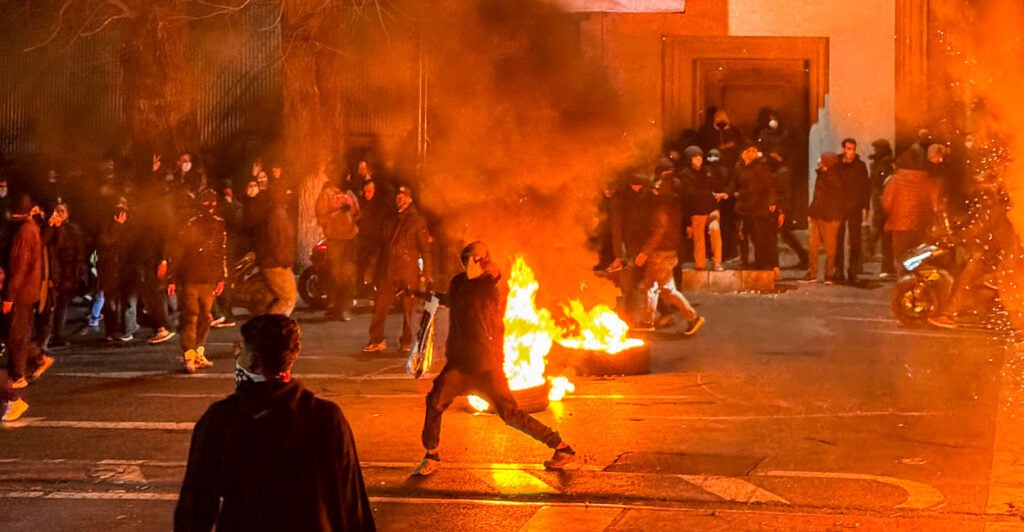
While multiple reports indicate hundreds of protesters have been killed in Iran, the real death toll is likely much higher, according to a Middle East policy expert.
“I think that thousands, if not over 10,000, are probably dead,” Gregg Roman, executive director of the Middle East Forum, told The Daily Signal, pointing to images of makeshift morgues coming out of Iran.
The Guardian published a video Monday showing large numbers of body bags lining the grounds outside a medical center in Tehran, and France 24 reported similar images.
WARNING: The video below contains disturbing images.

“This is probably the worst violence that the regime has extracted on its people since the revolution,” Roman said, referring to the Iranian Revolution in 1979.
Anti-regime protests have gained momentum in Iran over the past two weeks, in response to Iran’s failing economy and rampant inflation.
Information on the protests is limited due to regime-imposed internet blackouts, Reuters reports, although some Iranians have been able to access the internet through Starlink. President Donald Trump says he plans to speak with Elon Musk about using Starlink to restore widespread internet access in Iran.
Trump has acknowledged protester deaths, telling reporters Sunday that some were killed “through the stampeding … and some were shot.”
Roman said that the regime has used “extremely violent” means to crack down on protests.
Protesters “have sustained sniper bullets to their heads, they’ve been maimed by shotgun pellets, they’re choking on tear gas, and in cases in which they may have been trampled, it’s because they were probably fleeing regime security forces who were going after them with extremely violent means,” Roman said.
Trump threatened to act against the Islamic Republic over the killing of protesters, but had not specified what that action might entail. The Trump administration is in contact with Iran’s leaders, according to the president.
“Air strikes would be one of the many, many options that are on the table for the commander in chief,” White House press secretary Karoline Leavitt told reporters Monday, adding, “Diplomacy is always the first option for the president.”
Iranian Foreign Minister Abbas Araghchi told Al Jazeera Monday that the regime is ready for war.
“If Washington wants to test the military option it has tested before, we are ready for it,” Araghchi said.
In June, the U.S. carried out strikes on Iran’s three key nuclear facilities, damaging the regime’s nuclear capabilities.
If the U.S. chose to carry out another strike against Iran’s regime, Ayatollah Ali Khamenei does still have the capability of responding, according to Roman.
“They have their missile capabilities. They have the ability to still activate their proxies,” Roman said, referring to the Houthis and Hezbollah.
“But I think that the biggest thing that Iran did not activate in the June war, which they can do, is to activate their sleeper cells that they have that can target American embassies, synagogues—more soft targets that are not in Israeli territory, that are not U.S. bases in the region, but can hit the soft civilian underbelly of Western countries,” Roman said.
Regarding Trump’s “next move,” Leavitt says that is something “only he knows, so the world will have to keep waiting and guessing.”