


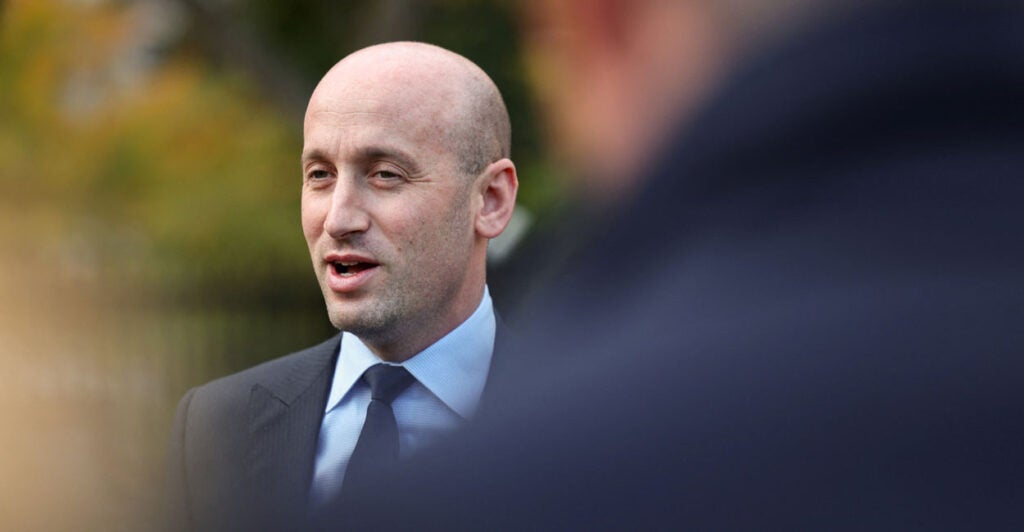
White House deputy chief of staff for policy Stephen Miller says birthright citizenship is essentially an “illegal” immigration program.
“One point not made enough on immigration: when you have a national program (an illegal suicidal one) of granting ‘birthright’ citizenship to the child of any and every foreigner who sets foot on your soil, you must be infinitely more cautious about who to allow into your country,” Miller wrote on X Tuesday.
The 14th Amendment to the U.S. Constitution established birthright citizenship in 1868, stating: “All persons born or naturalized in the United States, and subject to the jurisdiction thereof, are citizens of the United States and of the State wherein they reside.”
“Birthright citizenship also renders so many statistics invalid or absurd,” Miller continued. “If any foreign national comes to the US and has a child, and that child uses welfare, fails a state test, commits a crime, goes to jail, etc. those outcomes are all recorded in the ‘American’ column.”
President Donald Trump thrust the issue into the news on his first day back in office on Jan. 20, when he signed the executive order “Protecting the Value and Meaning of American Citizenship,” which aims to end automatic birthright citizenship.
Trump’s executive order focuses on the phrase “subject to the jurisdiction thereof” and claims that children born to illegal immigrants are not subject to U.S. jurisdiction and thus are not legal citizens.
Trump’s order further claims that citizenship does not automatically extend to a person whose father is not a citizen or lawful resident and whose mother is in the U.S. lawfully but only temporarily, such as through a visa program.
A coalition of states immediately sued to block Trump’s order, and on Dec. 5, the Supreme Court agreed to hear arguments in what is expected to be its biggest case of 2026.