


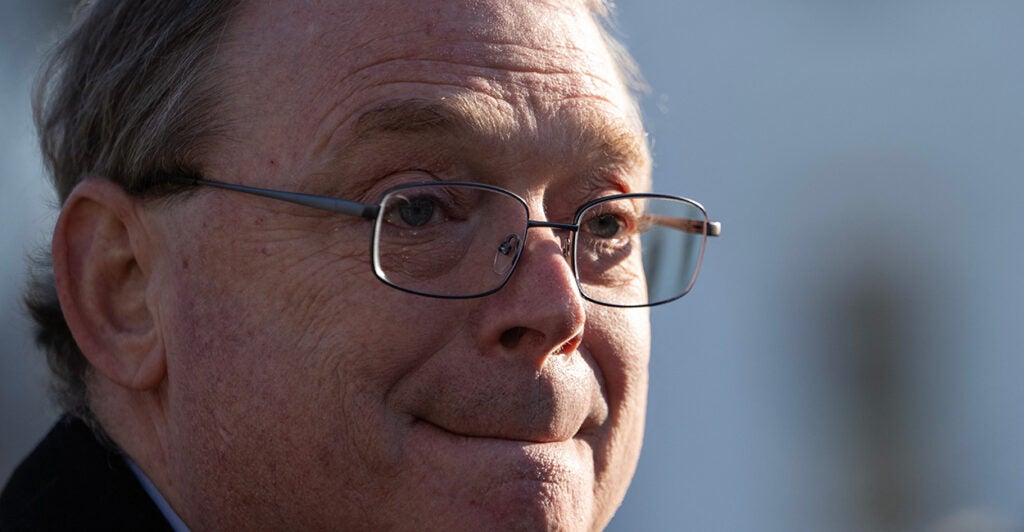
President Donald Trump recently told The Wall Street Journal he is favoring selecting either National Economic Council head Kevin Hassett or former Federal Reserve Governor Kevin Warsh for the next chair of the Federal Reserve.
Trump has said he expects the next Fed chair to cut interest rates.
How have the candidates under consideration approached interest rate cuts in the past?
Kevin Warsh
Following the 2009 financial crisis, Warsh was skeptical of cutting rates.
At the November 2010 Federal Open Market Committee meeting, Warsh expressed concerns about the Fed’s plan to stimulate the economy by lowering long-term interest rates through additional asset purchases.
“Given what ails us, additional monetary policy measures are, at best, poor substitutes for more powerful pro-growth policies,” he said.
Warsh said the Fed should be “leery of drawing inapt lessons from the crisis to the current policy conjuncture.”
“But when non-traditional tools are needed to loosen policy and markets are functioning more or less normally—even with output and employment below trend—the risk-reward ratio for policy action is decidedly less favorable,” he said. “In my view, these risks increase with the size of the Federal Reserve’s balance sheet. As a result, we cannot and should not be as aggressive as conventional policy rules—cultivated in more benign environments—might judge appropriate.”
Warsh maintained that the Fed should not be treated as a “repair shop for broken fiscal, trade, or regulatory policies.”
Despite Warsh’s mixed record on interest rates, economist and former Trump Bureau of Labor Statistics nominee EJ Antoni thinks Warsh understands that the next Fed chair needs to do more than adjust the Fed’s benchmark interest rate.
“The entire novel monetary framework that [current Federal Reserve Chair Jerome] Powell and his associates built in 2020 needs to be undone,” Antoni told The Daily Signal. “Powell has so thoroughly botched the job that any of his potential replacements would be infinitely better than him.”
Recently, Warsh has criticized Powell for being too hesitant to lower interest rates. He told Fox Business’ “Kudlow” program that he had “some sympathy” for Trump being frustrated with how Powell is handling interest rates.
“Economic growth in the U.S. is poised to boom, but it’s being held down by bad economic policies coming from the central bank, bad supervision policies, bad monetary policies, and a very confusing set of standards as we’ve gone from last year to this year,” Warsh said.
Kevin Hassett
Trump’s other top pick, Kevin Hassett, is a strong supporter of cutting interest rates in his positions in both of Trump’s presidential terms.
Hassett told The Wall Street Journal that while there may be “plenty of room” to cut rates, he would not cave to political pressure if inflation was high.
He told Fox News’ Bret Baier that if the Fed were data driven, it would lower rates.
“The president has expressed frustration with the policy decisions of the Fed,” he said. “And I think that that frustration that he has with the policy decisions is based on pretty sound analysis. The fact is that inflation is way down. Interest rates in the U.S. are amongst the highest anywhere on earth. And reducing interest rates would be sensible and would save the taxpayers lots of money right now.”
Christopher Waller
Previously, Treasury Secretary Scott Bessent said the short list also includes Fed Governor Christopher Waller and Fed Vice Chair of Supervision Michelle Bowman.
In March 2024, Waller said the data did not yet justify immediate rate cuts when inflation was still above target. He said that recent inflation and economic figures reinforced his view that the Fed should wait before lowering interest rates, adding that he saw “no rush” to cut rates.
“As a result, in the absence of an unexpected and material deterioration in the economy, I am going to need to see at least a couple months of better inflation data before I have enough confidence that beginning to cut rates will keep the economy on a path to 2% inflation,” Waller said.
But he changed his tune over the summer, saying that inflation was cooling and labor market risks were rising, showing it was time to ease policy.
“It makes sense to cut the [Federal Open Market Committee]’s policy rate by 25 basis points two weeks from now,” Waller told a gathering of the Money Marketeers of New York University in July.
Michelle Bowman
In September, when Bowman dissented from the Fed’s decision to cut rates by half a percentage point, she became the first Fed governor to dissent on an interest rate decision in 19 years.
She gave remarks at a bankers convention in May 2024 suggesting that illegal immigration was responsible for high housing prices.
“There is a risk that strong consumer demand for services, increased immigration, and continued labor market tightness could lead to persistently high core services inflation,” she said.
“Given the current low inventory of affordable housing, the inflow of new immigrants to some geographic areas could result in upward pressure on rents, as additional housing supply may take time to materialize,” she continued
While Bowman has kept the door open to lowering rates, she has warned against easing policy too soon. She said in August 2024 that rate cuts would be appropriate if inflation moves toward the 2% target.
“Should the incoming data continue to show that inflation is moving sustainably toward our 2% goal, it will become appropriate to gradually lower the federal funds rate to prevent monetary policy from becoming overly restrictive on economic activity and employment,” she said.
“But we need to be patient and avoid undermining continued progress on lowering inflation by overreacting to any single data point,” she continued.
None of the Fed chair candidates could be reached for comment.