





























Some people in government don’t even need a shutdown to avoid work.
Consider how Senate Democrats are handling President Trump’s judicial nominees. Or, to be more precise, not handling them.
Just before the Christmas break, The Hill reported, Democrats vowed to “reject any end-of-the-year deal on judicial nominations, signaling they’ll toe a tougher line on court appointments amid heavy pressure from the left.”
Typical politics, you say? Sure, partisanship is found on both sides of the aisle. No one can deny that. But the obstruction going on now with judges isn’t a tit-for-tat situation.
Consider what happened in 2014, the last midterm election year. As legal expert Thomas Jipping writes in National Review: “By the last two weeks of the 113th Congress, the Senate had confirmed 115 of President Obama’s judicial nominees, and judicial vacancies were down to about 65. Yet in those last two weeks, the Senate found time to confirm 17 more judges—15 of them without a roll call vote.”
That was no anomaly. The Senate has confirmed judges during 10 of the 11 lame-duck sessions following a midterm election since World War II. In 2014 and 2010, the Senate confirmed an average of 23 judges.
Today, however, with the vacancy situation clearly worse, there’s been no year-end push to confirm judges and to clear out some of the backlog.
That “heavy pressure” is really working. So much so, in fact, that what used to be a crisis magically isn’t anymore, even when it comes to what the Administrative Office of the U.S. Courts calls “judicial emergencies”—that is, vacancies that have been open the longest and have the most negative effects on the caseloads of sitting judges.
In March 2012, Democratic Whip Richard Durbin, senator from Illinois, said that 35 judicial emergency vacancies would cause the administration of justice to suffer “at every level.” Judicial emergencies are 80 percent higher today, yet we’re to believe everything is fine, judicially speaking?
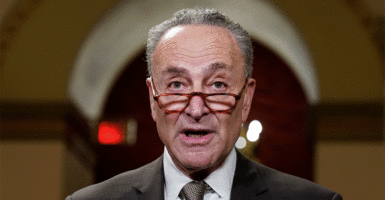
This isn’t about judges, of course. These foot-dragging politicians aren’t failing to do their duty because the nominees aren’t qualified. The main thing wrong with them, as far as Sen. Chuck Schumer, D-N.Y., and his colleagues are concerned, is who nominated them.
Politics, plain and simple, is throwing sand in the gears of the federal bench.
Today, more than 130 positions on the U.S. District Court and U.S. Court of Appeals are vacant. To put that in perspective, it’s more than twice as many vacancies as there were under President Bill Clinton or President George W. Bush.
Vacancies are 52 percent higher today than they were in July 2016, when Sen. Cory Booker, D-N.J., said we faced a “vacancy crisis.” What makes today’s vacancy situation any less of a crisis in Booker’s eyes, other than the occupant of 1600 Pennsylvania Avenue?
Vacancies are 88 percent higher today than they were in September 2015, when Judiciary Committee Chairman Patrick Leahy, D-Vt., warned that “we are heading into a judicial vacancy crisis.” He’s oddly silent now, despite the situation becoming roughly twice as serious. Or is it only a crisis when his party controls the White House?
This isn’t just about Trump, though. Democrats are trying to avoid having any more judges such as Reed O’Connor slip by. Confirmed in 2007 when they were in the majority, U.S. District Judge O’Connor recently struck down Obamacare in what Schumer called “an awful ruling.”
Yes, isn’t it awful when judges actually apply the Constitution and threaten to undo the legacy of bad laws such as Obamacare?
In the end, there’s no excuse for the road-block approach to judicial nominees. As Sen. Leahy put it in 2014: “Such obstruction is not worthy of the Senate, and the resulting judicial vacancies do great harm to the judicial system.”
It’s just as true today.
Originally published by The Washington Times

