New CBO Report Projects the 10-Year Deficit at $9.6 Trillion as Spending Grows
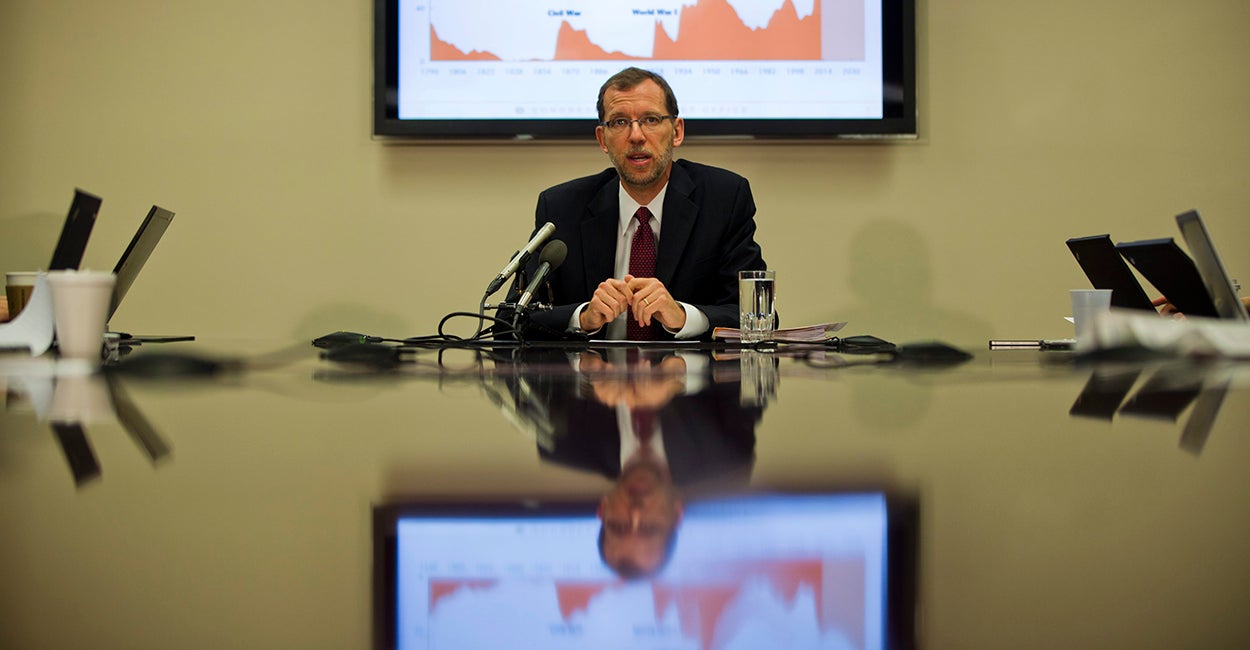
Today the Congressional Budget Office (CBO) released its 2014 Long-Term Budget Outlook, projecting U.S. spending, taxes, deficits, and the debt for the next 25 years. The CBO report stressed the nation’s unsustainable public debt path, calling it “a trend that could not be sustained indefinitely.”
This report should serve as a wake-up call to President Barack Obama and Congress which have devoted too little time since suspending the debt limit in February discussing how to address America’s dire fiscal outlook. While the president and Congress neglect the brewing budget crisis, the deficit keeps piling onto the debt.
Over the next 10 years alone, the CBO projects that the U.S. will accumulate $9.6 trillion in additional deficits. This figure includes the projected $7.6 trillion deficit under current law, also called the CBO baseline, and which assumes an unlikely tax increase among other policy changes (see CBO Table 1.2 for a full list of assumptions). Under this baseline scenario, public debt would exceed the size of the U.S. economy (measured in GDP) by the end of the 25-year period. Under the often times more realistic alternative fiscal scenario, the deficit would be higher by $2 trillion than under the baseline, and public debt would reach a staggering 180 percent of GDP by 2039.
In the CBO’s own assessment: “the high and rising amount of federal debt that CBO projects under the extended baseline would have significant negative consequences for both the economy and the federal budget.” The CBO even goes so far as to suggest that “[t]he large amount of debt could also compromise national security by constraining defense spending in times of international crisis or by limiting the country’s ability to prepare for such a crisis.”
If lawmakers instead made it their mission to return the publicly held debt to slightly above its historical average of about 40 percent of GDP by the end of the 25-year period, the CBO explains how lawmakers might get there: Congress would need to reduce the baseline deficit by $4 trillion (in addition to any effects such a reduction would have on interest costs) over the next 10 years, and maintain this same amount of deficit-reduction as a percentage of GDP for the rest of the period.
Of course, raising taxes to reduce the deficit is much more harmful to economic growth than cutting spending, as my colleague Salim Furth highlighted in a recent report on European austerity. Moreover, revenues are already above their 40-year average, according to the CBO, and are projected to continue rising. Rising spending is the real cause of higher deficits and debt as federal spending is on track to increase from consuming one-fifth of GDP a year to more than a quarter of the U.S. economic product before the end of the 25-year period.
TRENDING ARTICLES



Congress should cut spending and reform outdated entitlement structures to improve the U.S. fiscal outlook and secure prosperity for younger generations.
Read the first chapter of The Woketopus right now for FREE
Today, even with President Trump’s victory, leftist elites have their tentacles in every aspect of our government.
The Daily Signal’s own Tyler O’Neil exposes this leftist cabal in his new book, The Woketopus: The Dark Money Cabal Manipulating the Federal Government.
In this book, O’Neil reveals how the Left’s NGO apparatus pursues its woke agenda, maneuvering like an octopus by circumventing Congress and entrenching its interests in the federal government.
You can read the first chapter of this new book for FREE in this eBook, The Woketopus: Chapter One using the secure link below.
TRENDING ARTICLES

The Daily Signal depends on the support of readers like you.
RELATED ARTICLES




Don’t miss the

Don’t miss the signal