
Little-Known Issue Contributing to Deadly Muslim Attacks on Christians in Nigeria
Virginia Allen /
Persecution of Christians in Nigeria is not driven solely by religion, according to Pastor Brad Brandon.
While religion plays a direct role, socio-economic issues are a significant factor contributing to the bloodshed, says Brandon, founder and CEO of Across Nigeria, a Christian organization with the mission of bringing the Gospel of Jesus Christ to the people of Nigeria and supporting persecuted Christians in the African nation.
It is estimated that more than 50,000 Christians have been killed in Nigeria since 2009, and about 7,000 in the first half of 2025 alone.
A Missionary Calling
A decade ago, Brandon was pastoring a church in Connecticut when he realized his relationship with God “had become very stale.”
“I cried out to Him and just said, ‘God, I don’t want this anymore. I want to be back close with you and have that side-by-side walk with you again,’” Brandon tells The Daily Signal he recalls praying.
Shortly thereafter, Brandon got involved with Christian missions work in Nigeria. When he traveled to the African nation in 2016, he gave God the credit for leading him to a Fulani Muslim village, which became the start of Across Nigeria.
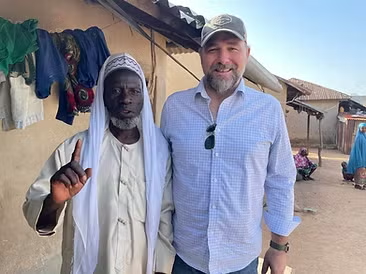
Brandon has dedicated much of the past 10 years of his life to serving Christians in Nigeria and building relationships with Fulani Muslims, giving him unique insight into current tensions between Christians and Fulani Muslims.
Why Fulani Muslims Are Attacking Christians
While Boko Haram and the Islamic State—West Africa are driven by their radical Islamic ideology to persecute Christians in Nigeria, many Fulani Muslims are in conflict with Christians over issues of farming and ranching.
“Although there are some militarized radical Fulani Muslims who are ideological in their beliefs and in their actions, I would say many of the Fulani Muslims are in conflict with the Christians … [because of a] lack of good grazing ground for their cattle,” he said.
Boko Haram and the Islamic State are terrorist groups, both of which have a strong presence in Nigeria, but the Fulani Muslims are an ethnic group in Northern Nigeria and are responsible for a great deal of the current violence being carried out against Christians.
“They raise cattle,” Brandon said of the Nigerian Fulani Muslims. “The Christians do farming [and] especially during the dry season, you’ll see an increase in the violence. When the cattle are looking for food, they’ll wander onto a farmer’s crops [and] destroy the crops. The farmer comes out, chases the cattle away, the Fulani come back and retaliate, and before you know it, hundreds of Christians are killed.”
Stopping the Fulani Violence
While the socio-economic issues do not justify the violence from the Fulani Muslims “it gives us an insight into how we can solve the problem,” the Christian missionary said.
“We’re helping those communities with wells, with medical care, with schools, because we want to increase their socio-economic position so that their young people aren’t drawn into radical ideologies and terrorism,” he explained.
To date, Across Nigeria has built eight schools serving over 4,000 students primarily in Fulani Muslims communities. Violence has dropped by 60% to 70% in every area where a school has been built, Brandon said.
One of the solutions to the tensions in Nigeria between Christians and Fulani Muslim is a ranching system that would include fences for cattle, which Brandon says is not a perfect plan, but does have “some good points to it.”
‘Christian Lives Are Expendable’
Brandon also places responsibility at the feet of the Nigerian government for allowing the persecution to continue.
About 25 years ago, Christians and Fulani Muslims lived peacefully side-by-side, Brandon explained. But because the “Nigerian government has been silent on the issue of Christians being killed,” Brandon says, the message to “the Fulani is that when we have a problem, Christian lives are expendable, and we’re not going to get in trouble for killing them.”
Additionally, Brandon say he believes that the instability in northern Nigeria is viewed as a benefit to and by the Nigerian government.
“It allows them to retain power,” he said the government. “It allows them to be able to do things in the north that they couldn’t do if it was stabilized.”
Trump in Action
The persecution of Christians in Nigeria has gained international attention, including from President Donald Trump, who at the end of October announced he was designating Nigeria a Country of Particular Concern.
Trump has also directed members of Congress to look into the issue of Christian persecution in Nigeria and report back to him.
“I’m appreciative of President Trump for drawing attention to this,” Brandon said, adding that “there hasn’t been a president in recent history that has done anything about this.”
When President Joe Biden entered the White House, he removed Nigeria from the Country of Particular Concern list despite the fact that persecution of Christians was taking place at the time.
Trump put Nigeria on the list of countries of Particular Concern during his first term, “so he’s always had his finger on the pulse of what’s happening in Nigeria,” the missionary said.